Laparoscopic Endometriosis Surgery in Istanbul: Fertility-Sparing Excision That Protects the Ovary
Many women receive a diagnosis of endometriosis or a “chocolate cyst” and are immediately faced with a difficult question: should I have surgery – and what does it mean for my fertility? With endometriosis it is often not whether you operate but how that decides the outcome, because the lesions can be thoroughly excised or only superficially ablated. At the practice of Associate Professor Dr. Cengiz Andan in Istanbul (Şişli) we follow one clear aim: to remove the endometriosis completely while sparing healthy ovarian tissue – and with it your fertility – as far as possible. For patients coming from the UK and abroad this means a planned operation with one surgeon who performs the procedure from beginning to end himself.
At a glance
- What it is: in laparoscopic endometriosis surgery the endometriosis lesions and cysts are removed through a few millimetre-sized incisions.
- Technique: complete excision rather than mere ablation – this lowers the recurrence risk.
- Ovary: sparing the ovarian reserve (AMH) is central, especially with the “chocolate cyst” (endometrioma).
- Wish to have children: the surgery can improve the chances of pregnancy – without a guarantee.
- From abroad: diagnosis and planning start online; the stay usually covers a few days.
What happens during laparoscopic endometriosis surgery?
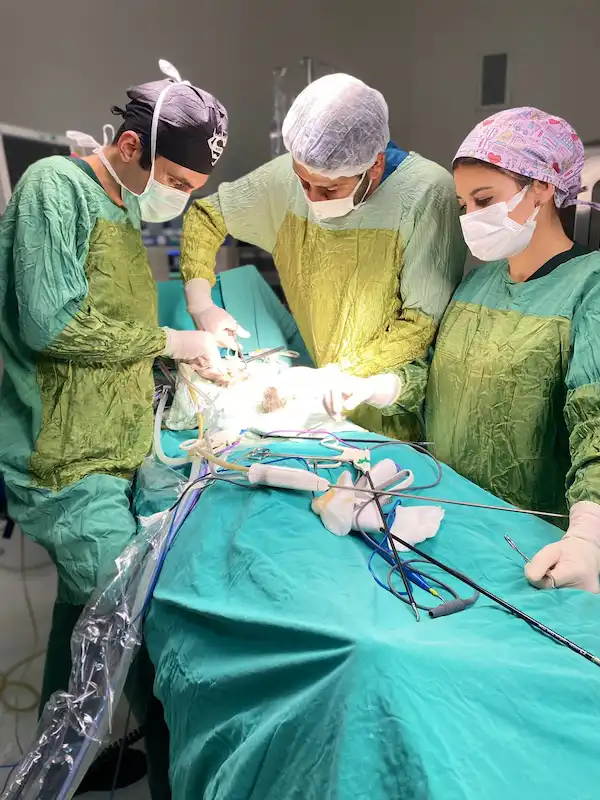
Endometriosis surgery is almost always carried out as a laparoscopy through a few small incisions. The camera is inserted through a port at the navel, one or two further small ports are used for the instruments, so that the surgeon can assess the entire abdomen under magnification. First the extent of the disease is assessed (staging) and a tissue sample is taken, then the visible lesions are removed and adhesions are released. An ovarian endometrioma is also treated in the same procedure. Only rarely, in about 5 % of cases, is it necessary to convert to an open incision.
Endometriosis, endometrioma or adenomyosis – what is the surgery about?
The surgery depends on which form of endometriosis is present. Superficial lesions lie on the peritoneum, while the endometrioma – the “chocolate cyst” – is a lesion on the ovary filled with old blood. Adenomyosis, in which the tissue grows into the uterine wall, must be distinguished from endometriosis, even though the two can occur together. When the disease grows deep into organs such as the bowel or bladder, this is called deep infiltrating endometriosis, which makes up about 10–20 % of cases and is covered in detail on a dedicated page.
| Form | What it means | Typical procedure |
|---|---|---|
| Peritoneal lesions | superficial on the peritoneum | excision of the lesions |
| Endometrioma | cyst on the ovary | gentle cystectomy |
| Adenomyosis | tissue in the uterine wall | usually medication |
| Deep infiltrating | growth into organs | specialised excision |
When should endometriosis be operated on – and when not?
Endometriosis affects about 6–10 % of women of childbearing age, but whether surgery is done depends on symptoms, findings and the wish to have children – not on the presence of lesions alone. Surgery is appropriate with severe pain, a growing endometrioma, an unfulfilled wish to have children or when medication does not help enough. With mild symptoms a hormonal therapy can be tried first. The important point: not every visible lesion has to be removed at once, because findings with few symptoms do not justify an unnecessary procedure.
How is the severity classified (rASRM and #Enzian)?
The severity of endometriosis is described with standardised classifications that guide the surgical planning. The rASRM classification distinguishes four stages from minimal (I) to severe (IV), while the #Enzian classification mainly maps deep and organ-related findings. This classification helps to plan the procedure realistically and to inform the patient honestly beforehand. It also makes clear why two women with “endometriosis” can need very different operations.
| rASRM stage | Severity |
|---|---|
| Stage I | minimal |
| Stage II | mild |
| Stage III | moderate |
| Stage IV | severe |
Source: European Society of Human Reproduction and Embryology (ESHRE), endometriosis guideline
Excision or ablation – why the surgical technique decides the outcome?
With endometriosis the technique largely decides recurrence, pain and fertility. The complete excision of the lesions also removes the deeper part and is regarded as the standard procedure, because it leads to recurrence less often and increases the chance of a spontaneous pregnancy. Mere ablation (coagulation), by contrast, stays on the surface and often leaves remnants. In experienced hands the complete removal of the visible lesions succeeds in around 90 % of cases.
| Feature | Excision | Ablation |
|---|---|---|
| Recurrence risk | tends to be lower | tends to be higher |
| Ovarian reserve | more affected | somewhat more spared |
| Spontaneous pregnancy | rather higher | rather lower |
Source: American Society for Reproductive Medicine (ASRM), recommendations on surgical endometriosis therapy
How is the ovarian reserve spared during endometrioma surgery?
With the endometrioma the preservation of the ovarian reserve is central to the surgery. The cyst itself already burdens the ovarian tissue before the procedure, and endometriomas occur in about 17–44 % of endometriosis cases.
During excision, healthy tissue can be removed unintentionally: the AMH value drops after a cystectomy in studies by about 37–46 %, but with optimal technique by only around 26–31 %. This is precisely why we use gentle haemostasis instead of aggressive bipolar coagulation and work especially carefully on the ovary.
Source: American Association of Gynecologic Laparoscopists (AAGL), recommendations on ovarian preservation with endometrioma
What does the surgery mean for my wish to have children?
For women who wish to have children, endometriosis surgery can improve the starting point; endometriosis is found in about 30–50 % of women with an unfulfilled wish to have children.
With minimal or mild endometriosis, removing the lesions noticeably increases the pregnancy rate – in analyses to about 31 % compared with around 18 % without a procedure. With an endometrioma the benefit must be weighed against the possible loss of ovarian reserve, which is why findings, age and AMH value are considered together. If artificial insemination is also planned, the order of surgery and IVF follows the individual findings.
Source: National Institute for Health and Care Excellence (NICE), guideline on fertility with endometriosis
Can endometriosis come back after the surgery?
Even after a thorough operation, endometriosis can recur – that is part of honest counselling. Depending on severity and the completeness of removal it returns over several years in about 10–30 % of cases; with the endometrioma recurrence rates of around 25 % are described over four years. An incomplete removal and a higher severity favour recurrence. Hormonal follow-up treatment can further delay symptoms and a recurrence.
Does the surgery really relieve the pain?
In many women the pain improves markedly after the lesions are removed, but there is no guarantee. Whether and how strongly period pain, pain during intercourse or chronic lower abdominal pain recede depends on the location and extent of the lesions. Studies show overall good results for complete excision, with a clear pain improvement in around 70 % of women. Serious counselling states these prospects openly, without promising a pain-free life.
What risks and complications does the surgery have?
Laparoscopic endometriosis surgery is regarded as safe, but patients should be aware of some risks. Serious complications such as injuries to the bowel, bladder or vessels are rare, in under 1 % of procedures, but the risk rises with the depth of the disease.
With deep infiltrating endometriosis involving organs the procedure is more demanding; a dedicated page offers detailed information on this. In our practice the complication rate across all procedures is around 2 %, and before every operation we openly explain the individual risks.
Does the uterus have to be removed with endometriosis?
No – removing the uterus with endometriosis is the exception, not the rule. In the vast majority of cases the lesions can be removed while preserving the organs, so that the uterus and ovaries are kept. A hysterectomy is considered at most when the symptoms severely limit life, other treatments have been unsuccessful and family planning is complete. The organ-preserving path is clearly to the fore.
What is the treatment approach of Associate Professor Dr. Cengiz Andan?
Our approach can be summed up in one sentence: remove completely, but preserve as much ovary and fertility as possible. We rely on the clean excision of the lesions rather than on extensive ablation and work on the ovary with gentle technique to protect the ovarian reserve. With a wish to have children we plan the procedure based on findings, age and AMH value and coordinate the order with a possible artificial insemination; with deep organ involvement we work multidisciplinary. We perform every procedure ourselves from the first to the last step and support our international patients after the return journey too.
Why is the surgeon's experience decisive with endometriosis?
With endometriosis in particular the outcome depends strongly on the surgeon, because the complete and at the same time gentle removal of the lesions is technically demanding. The treatment therefore belongs in specialised hands with corresponding experience. Associate Professor Dr. Cengiz Andan has performed over 500 endometriosis operations and has 18 years of experience in minimally invasive minimally invasive gynaecology. This specialisation is one of the reasons why patients from the UK and abroad also choose treatment in Istanbul.
How does recovery after endometriosis surgery proceed?
Recovery after laparoscopic endometriosis surgery is usually quick and in clear phases. Many women can leave the clinic after about one night, and some procedures are even possible as day surgery. Light everyday activities are often possible again after about 1 week, while heavy strain and sport should pause for around 2–4 weeks depending on the procedure.
Typical course:
- Day 0–1: getting up, discharge from the clinic
- Day 2–7: light everyday activities, walks
- from week 2: return to office work
- from week 3–4: slow increase, light sport
UK, your home country – or Istanbul? What is the difference?
The medical quality is very high in both cases – the difference lies not in the method but in waiting time, care and cost. In Istanbul the same minimally invasive techniques and the same international guidelines are used as at home. Waiting times for a planned appointment are often shorter, and the procedure is supported throughout by a single responsible surgeon. That the costs are lower has to do with the exchange rate and lower operating costs – not with compromises on the standard.
| Feature | Home country | Istanbul |
|---|---|---|
| Quality / standard | very high | very high |
| Waiting time for appointment | often longer | usually shorter |
| Surgeon continuity | can change | one responsible surgeon |
| Cost | higher | lower |
What happens with complications once I am back home?
The greatest concern of many patients from abroad is what happens in the rare case of a complication after the return journey. Complications are rare after endometriosis surgery, and for any such case we remain reachable after the procedure and coordinate if needed with the treating doctor in your home country. You receive a complete surgical report and the histological findings, which your doctor at home can use directly. This keeps the aftercare seamlessly organised across borders too.
How do I organise travel, stay and aftercare from abroad?
The process for international patients is planned so that as much as possible is prepared before the journey. Diagnosis and surgical planning begin online; existing ultrasound or MRI findings from home are a great help here. For most endometriosis operations a stay of a few days in Istanbul is enough. A flight is – depending on the procedure and medical clearance – usually possible again about 5–7 days after surgery; this gap lowers, among other things, the risk of travel thrombosis.
How do I get a medical second opinion – also online?
A well-founded second opinion can bring much clarity before a planned operation, especially when a hysterectomy or a repeat procedure has already been advised. If you send us your findings and imaging, we review them and assess whether an organ-preserving, gentle path is an option. This online consultation is a paid medical service and does not replace an examination on site, but helps with an informed decision. You can make contact simply by form or WhatsApp.
Frequently asked questions
In the vast majority of cases yes, because laparoscopy is gentler than a large abdominal incision. Only very rarely is open surgery needed. Through small ports the lesions can be removed and the diagnosis confirmed histologically at the same time.
With an endometrioma the cyst wall is excised as completely as possible to avoid recurrence. At the same time, care is taken to remove as little healthy ovarian tissue as possible. With very large or bilateral cysts this balance is especially important.
The duration depends on the extent of the disease and is often between about 1 and 3 hours. A localised endometrioma is dealt with faster than extensive disease with many adhesions. A precise estimate is only possible after reviewing the findings.
Endometrioma surgery can lower the AMH value, because ovarian tissue may be lost during excision. With gentle technique this loss can be limited, and part of the reserve recovers over time, but rarely returns to the starting value. The AMH value is therefore deliberately taken into account before surgery.
With a wish to have children an attempt is often possible in the months after the procedure, as the chances can be most favourable right after the lesions are removed. The right timing depends on findings, age and ovarian reserve. With planned IVF the sequence is set individually.
Endometriomas can recur; over several years the recurrence rate is around 25 %. Removing the cyst wall as completely as possible lowers this risk. Regular ultrasound checks help to detect a recurrence early.
Light activities are often possible again after about 1 week. Heavy strain and sport should pause for around 2–4 weeks depending on the procedure. The individual clearance depends on the healing course.
Pain during intercourse (dyspareunia) often decreases after complete removal of the lesions. How strong the improvement is depends on the location of the lesions, especially in the area behind the uterus. There is no guarantee of complete freedom from symptoms.
Deep infiltrating endometriosis is when the lesions grow deep into organs such as the bowel, bladder or ureter. Such procedures are more demanding and often require a multidisciplinary approach. You will find detailed information on a dedicated page about deep infiltrating endometriosis.
Depending on severity and the wish to have children, hormonal follow-up treatment can be useful to delay symptoms and recurrence. With an urgent wish to have children it is usually omitted in favour of an early attempt at pregnancy. The decision is made individually.
Helpful are existing ultrasound and MRI findings, earlier surgical reports and histological findings as well as the AMH value and a short description of your symptoms. The more complete the documents, the more precise the first assessment. Missing tests can often be done at home.
After your documents arrive a first assessment is made promptly. For a detailed medical assessment a paid online appointment is arranged. You can make first contact by form or WhatsApp.